This Autumn, the Labour party and Scottish National Party (SNP) conferences in Liverpool and Aberdeen gave room for some hope. Representing the Independent Food Aid Network (IFAN) at numerous panel sessions and at a joint event on child poverty in Scotland co-hosted by members of the Child Poverty Coalition, I was able to hear and appreciate some important shifts in ideas focused on a cash-first approach to food insecurity as well as momentum-building for urgent policy change.
First, a panel session on the political and economic need to tackle the cost of living crisis with Lucy Rigby KC MP. Alfie Stirling from the Joseph Rowntree Foundation was on point, talking about how it’s wrong that this issue is often framed as a choice: do we want to raise living standards or do we want growth? In reality, raising living standards can actually drive growth. For example, if people have a monetary cushion, they are more likely to take risks which have a positive impact on the economy; if people are financially worry-free they’re more productive at work; if people have secure housing, they’re more likely to have work consistently. Living standards provide critical input to a strong economy, they are not just an outcome.
Turn2us ran an excellent panel discussion on restoring trust in the social security system with Minister Stephen Timms. Sara Davies from Bristol University highlighted key findings from the recently released Turn2Us ‘Stigma in the system’report. The findings show how stigma harms people’s wellbeing and finances, as stigma means people are less likely to seek the support they’re entitled to. It was also alarming to hear how many non-claimants feel they’re not getting what they put into the system: very much a divided “us and them” situation.
A moving video was shown, depicting the real life experience of a mother whose life was suddenly changed by a debilitating illness prompting a discussion around the complex and cruel nature of the current system.
As part of its longstanding calls for immediate cash-first actions to reduce food insecurity, IFAN has been asking for the abandonment of devastating policies including sanctions, the two-child limit and the five-week wait for a first Universal Credit payment. It was encouraging to hear deep, thoughtful debate on all of these issues, recognising the harm that these policies have caused over the last 15 years. At least, there seems to be hope that the two-child limit will be addressed in the upcoming Autumn budget.
This session was followed by the Guarantee Our Essentials reception, attended by 100 or so people working in the sector and supporting the campaign. The work we do – fighting poverty and campaigning for change - can often feel bleak and hopeless. That’s why it’s wonderful to have moments like this, where people can come together and reflect on the progress that has been made.
The event was hosted by the Fabian Society, with several appearances from MPs such as Torsten Bell, Meg Hillier, Luke Murphy and Jeevun Sandhur. There was an excellent speech from Kate Bell of the TUC and valuable contributions from Essentials Voices members, people with lived experience of going without essentials whilst receiving Universal Credit. This film was shown, showing why organisations across the sector want an Essentials Guarantee. It was a privilege to meet so many in the sector and to have the opportunity to talk about IFAN’s work to promote a cash-first approach to food insecurity and the ‘Worrying About Money?’ resources project.
IFAN has been a member of the Sustain Alliance for many years, and so it was, as ever, a privilege to attend the session ‘Feeding Britain Fairly: How can we ensure Labour’s food strategy delivers for all’. An illuminating panel discussion (held in the middle of the exhibition hall, silent-disco style with headphones!) was led by Kath Dalmeny, CEO of Sustain. Kath referenced the progress that has been made with the Government’s commitment to the Crisis and Resilience Fund. It was inspiring to hear from Daniel Zeichner MP (previously Minister for Environment, Food and Rural Affairs), who has done such valuable work developing the Good Food Cycle, developed with input from numerous organisations including IFAN.
Anna Taylor from the Food Foundation and Sue Pritchard from the Food, Farming and Countryside Commission made excellent contributions, encouraging us to think about what’s getting in the way of change? There was an abundance of provocative thinking such as how can we challenge the asymmetry of power in this area, where the voice from industry is so dominant. How can we bring in other voices? With this in mind, it was so refreshing to hear from David Njoku of the Citizens Advisory Panel, talking about his own experience feeding his family on a limited budget, and how this has informed his views and desire for urgent change. This session stood out for its powerful, inquiring thoughts around the systemic change that’s needed to the food system as a whole.
When discussing the need for increased social security spending, a question that always arises is “but where is the money going to come from?”. With this in mind, it felt important to attend the ‘Taxing the super-rich: why, now and what next’, hosted by the Patriotic Millionaires and Tax Justice. This was an excellent, enlightening session, expertly hosted by young backbench MP Noah Law (a financial analyst by trade, Noah is passionate about tax innovation and has actually started a competition for graduates, looking for innovative tax solutions!)
The main policy idea of both the Patriotic Millionaires and Tax Justice is a 2% wealth tax on income over £10 million. Phil White of the Patriotic Millionaires (himself a multi-millionaire) talked passionately about how it’s not just about raising more money, but more importantly, it’s about community and social cohesion. Do we want to live in a world where the super-wealthy live entirely separately?
A couple of weeks later I was off to Aberdeen for the SNP conference Long-established for our work promoting a cash-first approach to food insecurity, IFAN shared a stall with Trussell colleagues enabling us to talk about our joint vision for ending the need for charitable food provision with elected representatives. Alongside Trussell’s Cara Hilton and Michael Calder, I had numerous engaging conversations with SNP MPs, MSPs and councillors.
It was heartening that in many of our conversations, people were already familiar with the concept of a cash-first approach to food insecurity and were using IFAN’s ‘Worrying About Money’ resources in their local area. There is a greater sense of momentum in Scotland to end the need for food banks, driven by the Scottish Government’s plan towards this aim, published and initiated in 2023 . However, many people we spoke to expressed concern that change isn’t happening fast enough.
As part of the End Child Poverty coalition, IFAN also co-sponsored a panel discussion: ‘The Scotland that is possible: eradicating child poverty’. The event was exceptionally well-attended, with standing room only. The panel was moderated by John Dickie, Child Poverty Action Group in Scotland director, and included Shirley Anne Somerville, MSP for Dunfermeline and Cabinet Member for Social Justice.
Dave Hawkey from policy change charity IPPR Scotland talked about the Scottish government target for child poverty: fewer than 10% of children in poverty by 2030. Currently child poverty is reducing, but not enough - if it continues at the current rate, by 2030 it will be 22%.
A big theme of the discussion was the two-child limit and the urgent need for its abolition. This change alone will have the biggest impact on child poverty numbers. Shirley Anne Somerville raised the challenge that social security spending can be seen by the public as “wasteful” rather than an investment.
Mary Glasgow from Children First, spoke powerfully about the need to protect children from the harms caused by poverty. Linda, a parent from the Changing Realities project, talked movingly about her own experiences and struggles and the constant barriers placed in the way of support.
The session ended with a lively Q and A, demonstrating again that perhaps Scotland is a step further than the rest of the nation in terms of a cash-first approach to food insecurity, with more than one audience member raising a question about universal basic income.
Later that day, there was another excellent event focused on child poverty ‘Can Child Poverty be eradicated?’, run by the University of Glasgow Centre for Public Policy (UofGCPP). This also featured Shirley Anne Sommerville, this time joined by Chris Birt from JRFn. Chris made the point that it’s wrong to believe that Scotland is doing well tackling poverty, just because the numbers are better than the rest of the UK. He was clear that this was a low bar.
The panel also included Professor Kezia Dugdale, previously leader of Scottish Labour, now an associate director at the UofGCPP, who referenced her study on the State of Poverty and the broad systemic change that’s needed. Professor Dugdale was clear that we must look further than social security: to the labour market, housing, childcare and so much more.
Finally, in addition to the stall and panel events, the conference provided a wonderful opportunity to spend time with IFAN allies such as The Poverty Alliance.
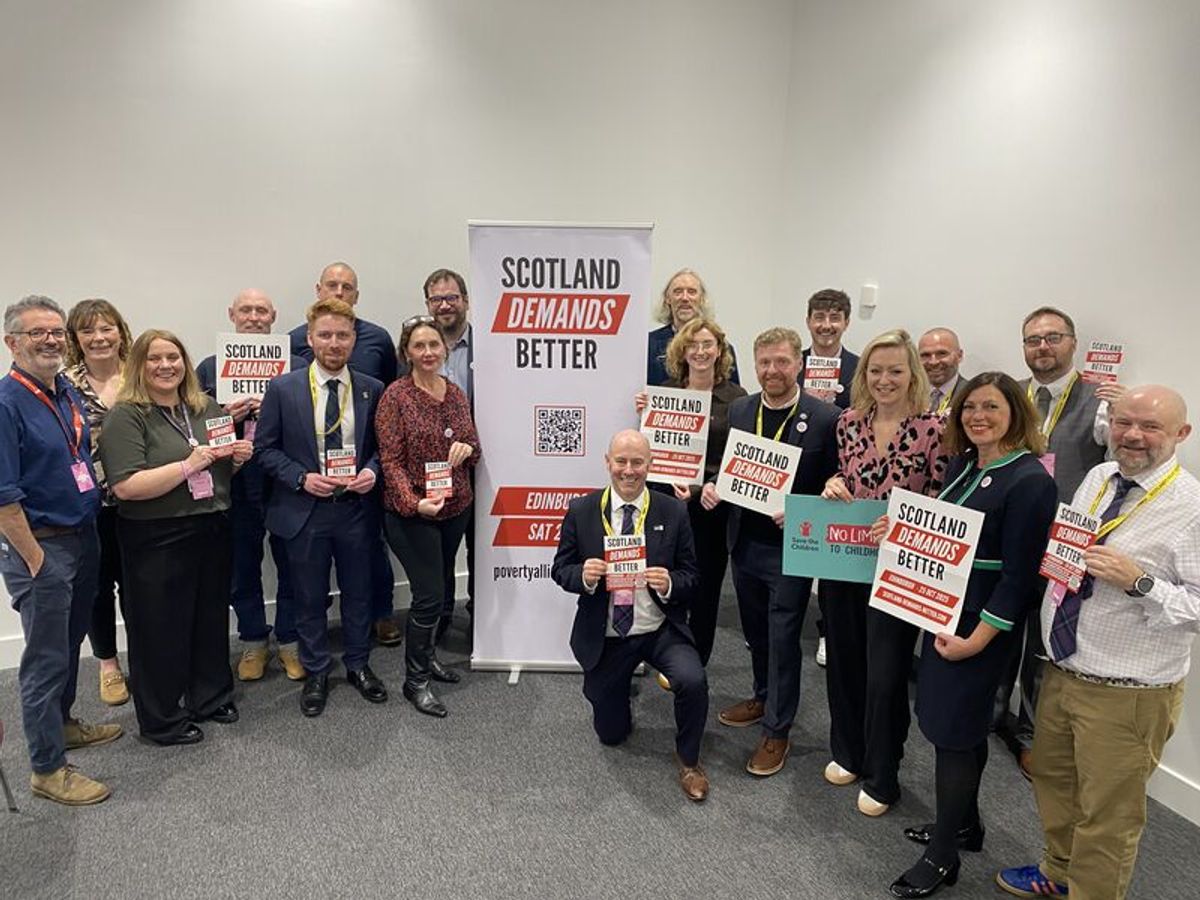
Shortly after the conference, the Scotland Demands Better rally, organised by The Poverty Alliance and attended by thousands of people took place in Edinburgh. Many IFAN members attended this rousing event. There was a real sense of not only hope and solidarity, but also urgency.
So, coming out of the conference season, there’s a growing sense of hope, especially in the area of child poverty where there are widespread expectations that the devastating two-child limit will finally be removed this Autumn. However, putting any movement on that policy into context. This change will represent a drop in the ocean when it comes to the scale and escalation of poverty in this country. Bigger, braver choices need to be made, difficult realities need to be addressed, but in doing so, there’s a promise of a Healthy Standard of Living and a Living Income for all.
Where next?
Follow our work
One timely email each quarter and we'll never share your details
Find out more about our privacy policy